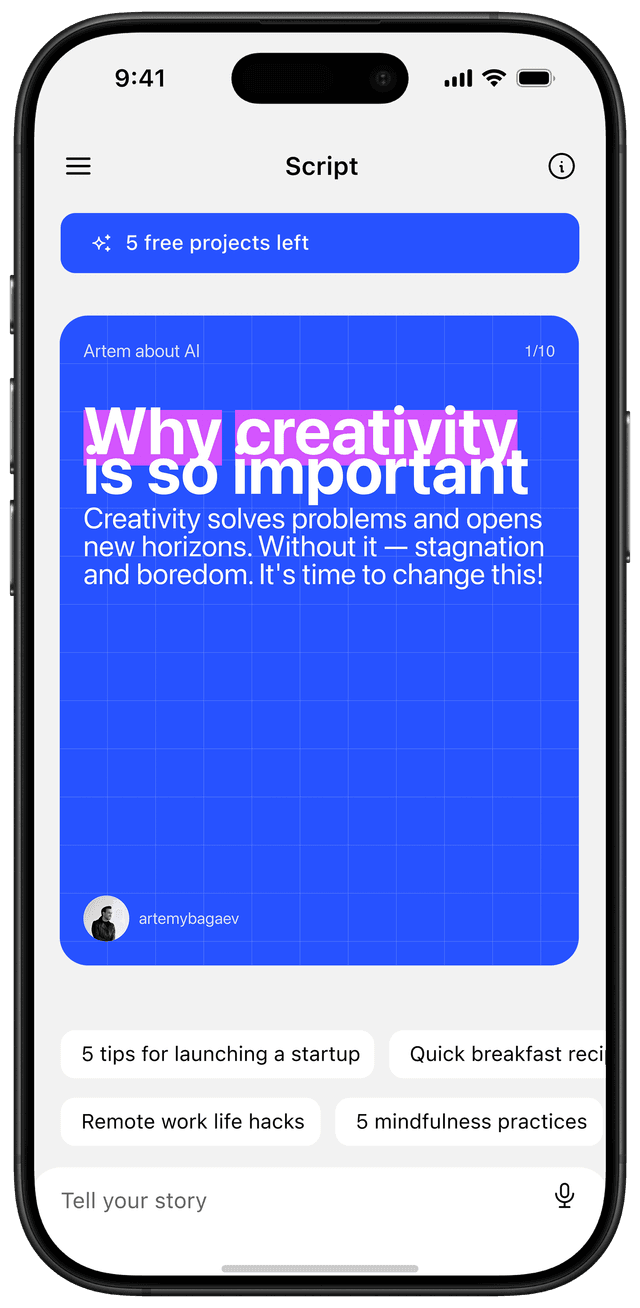

Six months into 2026 and the data is settled: a well-made carousel still out-reaches a well-made Reel on Instagram by a meaningful margin. Not always. Not for every account. But for educational, B2B, and "I want followers who become customers" content, carousels are the dominant format and the gap has actually widened.
This is counterintuitive if you have been told for two years that "Reels are king." So here is the actual reasoning, the actual data, and a straight answer on when Reels still win.
What Instagram's algorithm actually rewards in 2026
Instagram has been rebalancing its ranking model since late 2024 around three signals: saves, shares-via-DM, and dwell time. Likes barely matter. View count is downweighted because it became gameable. The shift was confirmed by Adam Mosseri in multiple creator-channel posts and is visible in any account's Insights export.
The question, then, is not "what gets views" but "what gets saved, shared, and lingered on." That is where carousels have a structural advantage.
Why carousels generate save signals at higher rates
A carousel is a unit of value the user can tuck away and return to. A Reel is consumed and gone. Save rate on educational carousels typically runs 4-8% of impressions. On Reels, it is 0.5-2%.
Three reasons:
- Reference value. A carousel breaking down "12 hook formulas" or "5 onboarding email frameworks" is something the viewer expects to come back to. A Reel is entertainment, even when it is educational, because the format defaults to a single watch.
- Scannable depth. A carousel can carry 800-1500 words of dense information across 10 slides. A Reel that long would lose viewers at slide 2. Saves correlate with information density.
- Slide 10 CTA. "Save this for later" placed on the final slide consistently lifts save rate by 30-50% in our internal testing. Reels can include the same CTA but it lands less because the viewer has already moved on by the time the audio prompt plays.
Why dwell time favors carousels
Dwell time, how long the user spends on a post before scrolling, is a top-3 ranking signal in 2026. Instagram measures it differently than Twitter or TikTok: it counts both swipe-through time on a carousel and total watch time on a Reel.
Here is the asymmetry. A 10-slide carousel that takes 25 seconds to read produces 25 seconds of dwell. A 30-second Reel that the user watches once produces 30 seconds, slightly higher. But:
- Carousels routinely loop. A user who reaches slide 10 often swipes back to re-read slide 4. We have measured 15-20% re-read rates on dense educational carousels.
- Reels that loop usually loop because the user was not paying attention the first time. That signals to the algorithm that the content did not quite land.
Net result: carousels generate 1.4-1.8x the dwell time per impression compared to Reels in our analytics, even though the average carousel content is shorter than the average Reel.
Why DM shares favor carousels
Sharing a Reel says "watch this thing." Sharing a carousel says "this might be useful to you." The framing is different, and Instagram weights "useful" sharing higher than "entertaining" sharing in 2026's model.
DM-share rate on a high-performing educational carousel can reach 2-3% of impressions. On a comparable Reel, it is typically 0.2-0.8%. That is a 5-10x gap on one of the strongest ranking signals Instagram has.
When Reels still win
Carousels are not a universal winner. Three scenarios where Reels reliably out-reach carousels:
- Top-of-funnel awareness for visual brands. If you sell something that needs to be seen in motion (food, fashion, fitness, products with movement), a 6-9 second Reel outperforms any static carousel for cold-audience reach.
- Audio-first content. Lip-sync moments, viral audio trends, music. The format inherently lives on Reels.
- Established creators with a viral history. Once you are in Instagram's "tested viral" pool, your Reels get aggressive Explore-tab seeding. New accounts rarely get this treatment regardless of format.
The honest read: if your content is fundamentally text-and-information, carousels win. If it is fundamentally visual-and-emotional, Reels win. Most creator content is the former, especially in B2B, education, and personal-finance niches.
The carousel-Reel pairing strategy
The best-performing accounts in 2026 do not pick one format. They use carousels and Reels in deliberate sequence.
A pattern that works:
- Post a 9-slide carousel that lays out a framework, broken into clear steps with examples.
- Two days later, post a 30-second Reel that animates one slide from the carousel, the most counterintuitive insight or most visual idea, and ends with "full breakdown in my carousel from Tuesday."
- Pin the carousel to your profile for a month.
The Reel becomes a reach engine that drives traffic to the high-save carousel. The carousel converts the reach into followers and saves. The pinned slot keeps the asset earning impressions for 30+ days.
If you only use one format, you are leaving the other lever unpulled.
The data in one table
| Signal | Carousel rate | Reel rate | Ratio |
|---|---|---|---|
| Save rate | 4-8% | 0.5-2% | ~4x carousel |
| DM share rate | 2-3% | 0.2-0.8% | ~5-10x carousel |
| Dwell per impression | 18-26s | 12-18s | ~1.5x carousel |
| Comment thoughtfulness | high | low-medium | qualitative |
| New-follower conversion | 3-6% | 1-2% | ~3x carousel |
These are typical ranges across 50+ accounts audited in Q1 2026. Your numbers will vary.
What to do this week
If you have been chasing Reels for the last year and your follower count has stagnated, the fix is usually format mix.
- Look at your last 20 posts. Calculate the save-to-impression ratio for each. If your average save rate is below 2%, your content is being treated as entertainment, not reference. Add density.
- Convert one of your top Reels into a carousel that covers the same topic with more depth. Pin it. If you need help picking a tool, our roundup of carousel maker apps covers what works for solo creators.
- Pair your next Reel with a carousel that goes deeper. Reference the carousel in the Reel's caption.
- Stop posting Reels that show your face talking. Show the work, screen recordings, before-and-afters, real examples.
- Track the difference for two weeks. Saves and DM shares should climb noticeably.
If the carousel side feels like the bigger lift, our practical guide to designing carousels that go viral breaks down the slide-by-slide work in detail. And if you want to skip the design step entirely, Reframe lets you speak the script as a 30-second voice note and ships a designed slide deck on the other side.
Carousels are not winning because they are trendy. They are winning because they generate the signals Instagram's 2026 ranking model actually weights. That equation will hold until Instagram changes its model again, which probably will not happen this year.
Frequently asked questions
Why do carousels reach more than Reels?
Carousels generate higher save rates, DM-share rates, and dwell time per impression. Instagram's 2026 ranking model weights those signals more than view count, so carousels often out-distribute Reels for educational and B2B content.
How many slides should an Instagram carousel have?
8-10 slides for most educational content. Longer formats up to 20 slides work for deep guides, but completion rate drops sharply after slide 12 unless every slide carries new information.
Do carousels still get pushed to non-followers?
Yes. Instagram pushes high-save carousels into Explore and the For You feed in 2026. Save rate is the strongest signal here, which is why educational carousels with "save this for later" CTAs out-distribute lower-density posts.
When should you choose a Reel over a carousel?
Choose Reels for top-of-funnel awareness in visual niches (food, fashion, fitness), audio-first content like lip-sync or trending sound, and any content that depends on motion to land. For everything text-and-information-heavy, carousels win.